


The Demolition of Anglia Square: A Community’s Farewell
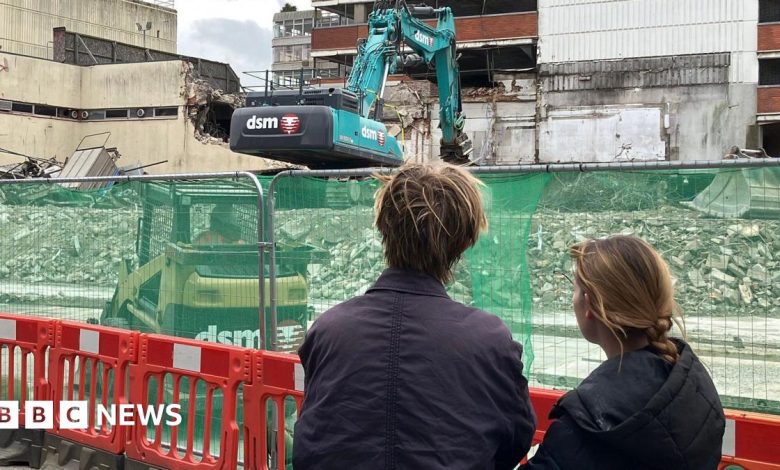
Anglia Square in Norwich has become a gathering point for locals who come to witness the demolition of what has been a fixture in their city for generations. Among them is McPherson, a photographer documenting the site’s final days. With personal memories of visiting the square throughout the 1980s and 1990s, McPherson describes it fondly as a “little city within a city.” His motivation goes beyond mere documentation; it’s about preserving visual memories for future generations who will never know what once stood there. “It’s been there all my life,” he reflects, his camera capturing the systematic dismantling of a place that has been woven into the fabric of Norwich’s identity for decades.
The square exists in a curious limbo that resonates with residents – as McPherson puts it, “people have been waiting for something to happen.” The demolition brings a sense of resolution to a community that has witnessed the area’s slow decline, providing what he describes as “closure for people.” This sentiment reveals how physical spaces become repositories of collective memory and identity, where even the removal of a struggling development can feel like the turning of an important page in a city’s story. The demolition marks not just the end of a building complex, but the conclusion of a chapter in Norwich’s shared experience.
What’s particularly striking about the scene is the diverse cross-section of society drawn to witness this transformation. McPherson notes the wide demographic range of those who stop to watch: “students walking past, people in their 80s” – spanning generations with different connections to and memories of the space. Some remember it in its heyday, others know only its faded present, but all seem to recognize the significance of this moment of transition. The demolition has inadvertently created a temporary community of observers, united by their connection to a place that means something different to each of them.
A core group of about 30 to 40 regular onlookers has formed, creating an impromptu community of witnesses to this urban transformation. Historians and photographers, including McPherson, have become familiar faces to one another, diligently documenting each stage of the demolition process. They’ve established an unspoken routine, returning daily to monitor progress and preserve what they can through their respective mediums. This dedicated group stands as testimony to how deeply physical spaces can matter to people, even when those spaces have fallen into decline. Their presence transforms what could be a simple demolition into something more meaningful – a community observing a significant moment in their shared urban history.
The location of the demolition on a busy thoroughfare ensures a constant flow of passersby who pause in their daily routines to observe the changing landscape. This creates a dynamic environment where the boundaries between deliberate observers and casual onlookers blur. Conversations start between strangers who would otherwise pass without interaction, sharing memories and perspectives on the square and speculating about what might replace it. These fleeting connections highlight how changes to the physical environment can temporarily alter social dynamics, creating spaces for connection in a world where such spontaneous community moments have become increasingly rare.
As Anglia Square slowly disappears, McPherson’s photographic project takes on greater significance. What began as personal documentation has evolved into an important historical record and a catalyst for community reflection. His images capture not just crumbling concrete and scaffolding but the end of a place that, despite its flaws, mattered to the people of Norwich. The project exemplifies how ordinary citizens often become the custodians of local history in times of change, preserving memories that might otherwise be lost. When the dust finally settles and whatever comes next takes shape, McPherson’s photographs and the shared experience of witnessing this transition will remain as testament to what once was – a “little city” within Norwich that, for better or worse, was part of the city’s identity for generations.






2qjbvn