Celebrating the Life and Legacy of Bishop Timothy Dudley-Smith
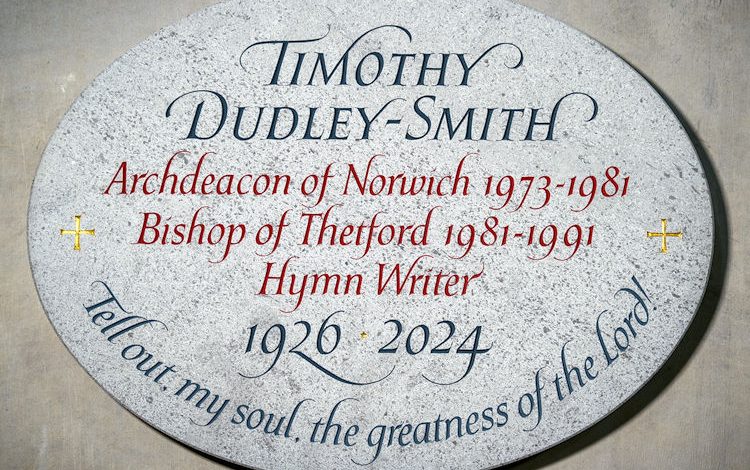
Norwich Cathedral was filled with music and memories on Sunday, March 22, as a special Choral Evensong service honored the remarkable life of Bishop Timothy Dudley-Smith. The solemn yet joyful occasion brought together family, clergy, and admirers to celebrate a man whose words have touched countless worshippers through his extraordinary gift for hymn writing. As Norwich Cathedral Choir’s voices soared through the ancient stone arches, singing his beloved hymn “Tell out, my soul,” the moment perfectly captured the essence of a life dedicated to expressing faith through poetry and music. Bishop Timothy, who served as Archdeacon of Norwich from 1973 to 1981 before becoming Bishop of Thetford until his retirement in 1991, left behind not only his episcopal legacy but also an unparalleled contribution to sacred music, having penned more than 450 hymns during his lifetime. His passing in Cambridge in August 2024 marked the end of an earthly journey, but the memorial stone unveiled in the Cathedral’s North Transept ensures his presence will continue to inspire visitors for generations to come.
The Bishop of Norwich, the Rt Rev Graham Usher, offered a touching tribute during his sermon, drawing a poetic connection between Bishop Timothy’s origins and his eternal remembrance: “From his childhood in Buxton, God carved Timothy out from the Derbyshire stone in which he was set and gave him life, with the name Jesus etched on Timothy’s heart and proclaimed with his lips. Now, as we dedicate a plaque to his memory, Timothy’s name is chiselled again into Derbyshire limestone, but God’s Holy Word echoes through his hymns to be written in our hearts.” The imagery of stone—both the Derbyshire limestone of his birthplace and now his memorial—provided a powerful metaphor for a life whose solid foundation in faith produced words that would outlast the man himself. Bishop Usher concluded his reflection with a challenge that echoed the themes prevalent in Bishop Timothy’s own hymns, encouraging those present “to live for Christ alone,” a sentiment that captured the essence of the late bishop’s personal mission and ministry.
The service was made especially meaningful by the participation of Bishop Timothy’s family, including his son, Rev James Dudley-Smith, who read the first biblical lesson from Jeremiah. The second reading from the Gospel of John was delivered by Songs of Praise presenter Pam Rhodes, whose presence highlighted Bishop Timothy’s significant contribution to modern Christian worship music. Rhodes also introduced another of his compositions, “Name of all majesty,” while a third hymn, “Lord, for the years,” was included in the service, offering those gathered a small sample of his vast repertoire. These musical selections served as living testaments to Bishop Timothy’s extraordinary ability to craft lyrics that simultaneously honored ancient theological truths while speaking in accessible language that resonates with contemporary worshippers. His hymns, characterized by scriptural fidelity and poetic craftsmanship, have become staples in church hymnals across the English-speaking world.
The evensong celebration was more than a memorial; it represented a continuation of Bishop Timothy’s lifelong commitment to the church’s mission. As the former president of the Evangelical Alliance, he worked tirelessly to promote Christian unity and gospel proclamation, seeing his hymn writing as an extension of this evangelistic impulse. His compositions have the remarkable quality of being both doctrinally rich and emotionally stirring, helping generations of Christians articulate their faith through congregational singing. From grand cathedral services to humble parish gatherings, Bishop Timothy’s words have given voice to the prayers, praises, and aspirations of countless believers, crossing denominational boundaries with their universal appeal and biblical foundations.
The memorial stone dedicated during the service serves as a physical reminder of Bishop Timothy’s connection to Norwich Cathedral and the Diocese he served faithfully. However, his most enduring monuments are less tangible—they exist in the hearts and memories of those who continue to sing his hymns, and in the spiritual formation of Christians who have been shaped by his poetic expressions of faith. What makes Bishop Timothy’s contribution particularly significant is how his work bridges traditional and contemporary forms of worship. While firmly rooted in Anglican traditions, his hymns have been embraced across denominational lines, appearing in hymnals from various Christian traditions and being sung in diverse worship settings worldwide. This universal appeal speaks to his exceptional gift for expressing complex theological concepts in language that remains accessible, memorable, and singable.
As the service concluded and attendees gazed upon the newly dedicated memorial stone, there was a palpable sense that while Bishop Timothy’s earthly life had ended, his ministry continued through his enduring hymns. The carved limestone bearing his name in Norwich Cathedral’s North Transept stands as a testament to a life well-lived in service to God and the Church. Yet perhaps more significantly, the living legacy of Bishop Timothy Dudley-Smith resonates whenever congregations worldwide join their voices to sing his words. In church buildings grand and modest, in celebrations and in times of sorrow, his carefully crafted phrases continue to help believers articulate their faith. As one of the Anglophone church’s most beloved hymn writers of recent times, he achieved what few others have: creating a body of work that speaks to contemporary hearts while remaining rooted in timeless truths, ensuring that generations yet unborn will continue to “tell out” their souls with his words upon their lips.