


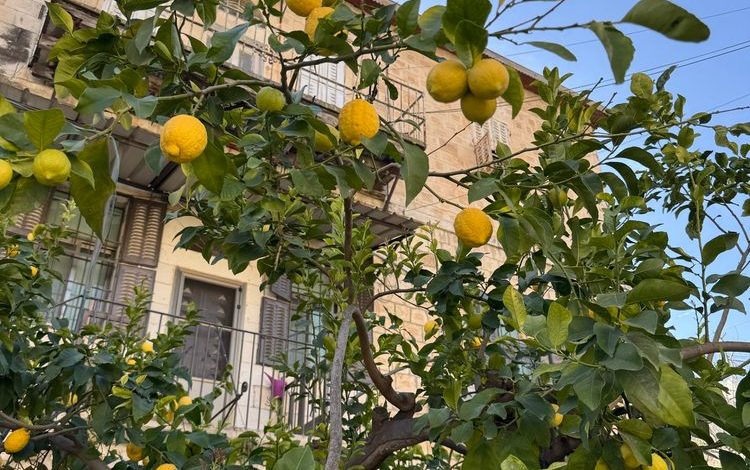
A Royal Connection Through a Simple Gift: King Charles and the Palestinian Lemon
In a touching display of cross-cultural connection, King Charles was visibly delighted upon receiving a rather unusual gift at the Royal Premiere of his film “Finding Harmony – A King’s Vision” at Windsor Castle. Among distinguished guests including Dame Judi Dench, Sir Rod Stewart, Sir Kenneth Branagh, Benedict Cumberbatch, and Kate Winslet stood the Bishop of Norwich, the Rt Revd Graham Usher, carrying a humble yet meaningful present: a hand-picked lemon from Palestinian soil. This simple fruit, grown in the garden of St. Philip’s Church in Nablus, created an unexpected bridge between the British monarch and Christians living in challenging circumstances in the Holy Land. The King’s warm reception of this modest gift—smiling as he inhaled its fragrance—spoke volumes about how small gestures can transcend geopolitical complexities and connect people at a profoundly human level.
The journey of this lemon began with Father Jameel Maher Khader, an Anglican priest from Nablus in the West Bank, who entrusted it to Bishop Graham during the latter’s solidarity visit to Palestinian Christians alongside the bishops of Chelmsford and Gloucester. Their mission was to support increasingly vulnerable Christian communities in Jerusalem and the West Bank, and included joining Jewish Rabbis from the “Rabbis for Human Rights” group to plant olive trees on land outside Bethlehem owned by Christian Palestinians. When Father Jameel learned that King Charles had been touched by his gift, he expressed profound satisfaction: “It fills me with quiet joy. Knowing that he took a moment to smell it and smile reminds me that even simple things can cross great distances and touch the heart.” His words reflect a profound understanding that genuine human connection doesn’t require grandeur—sometimes the most meaningful exchanges come wrapped in the simplest packages.
Father Jameel’s choice of a lemon was deliberate and laden with symbolism. “I wanted to offer something very ordinary and very Palestinian—something grown with care, from our own land,” he explained. “A lemon felt honest and humble, a small sign of life and generosity from our community in Nablus.” The citrus and orange trees growing beside his church carry deeper significance in a region marked by conflict. “The church is meant to be a place of life,” Father Jameel reflected. “These trees remind us that faith is rooted in the land and shared with others—they give shade, fruit, and hope. Lemons are part of our daily life—they speak of home, hospitality, and resilience. Even in difficult times, the trees keep bearing fruit.” In this context, the lemon becomes not merely a fruit but a powerful metaphor for perseverance, life continuing despite hardship, and the sweet-sour complexity of existence for Palestinian Christians maintaining their faith in challenging circumstances.
Bishop Graham’s role as intermediary in this exchange highlights the ongoing efforts of religious leaders to build bridges across political divides. “It was a joy to deliver this small gift from Palestinian Christians to His Majesty,” he said. “They wanted to share their harvest and send one of their beautiful lemons to The King. These Christians are keeping the light of Christ alive in the land of his birth while living under constant challenges.” The bishops’ visit itself was significant—standing in solidarity with a Christian community that feels increasingly marginalized and forgotten amid the region’s larger conflicts. By planting olive trees alongside Jewish rabbis on Palestinian Christian land, they demonstrated a commitment to interfaith cooperation and practical support that transcends headlines about division. The Bishop’s delivery of the lemon to King Charles completed a circle of connection between Christians in the Holy Land and one of the world’s most prominent Christian monarchs.
The setting for this humble exchange—the premiere of “Finding Harmony: A King’s Vision”—adds another layer of significance to the gift. King Charles’s 90-minute documentary explores his lifelong interest in nature, environmentalism, religion, art, and design, articulating his belief that humans must work in harmony with the natural world. The film, which features Bishop Graham briefly during a sequence showing the Coronation ceremonies, aligns perfectly with the symbolism of the Palestinian lemon—both speak to connections between people and the land, sustainability, and respect for natural bounty. That the King would appreciate such a gift is unsurprising given his well-documented environmental concerns and appreciation for organic farming. The documentary, set for release on Prime Video on February 6, offers the public insight into the monarch’s vision for a more harmonious relationship between humanity and nature, echoing in many ways the values embodied in the simple gift he received.
This seemingly small interaction—a King receiving a lemon—encapsulates much larger themes of diplomacy, faith, environmental stewardship, and human connection across divides. In a world often focused on grand gestures and formal exchanges between nations, this personal moment reminds us of how individual relationships can quietly build understanding. Father Jameel’s hope that the lemon “might prompt a thought or a prayer for peace” speaks to the power of tangible gifts to evoke empathy and remembrance. For the Palestinian Christians maintaining their presence and faith in increasingly difficult circumstances, knowing their small gift brought a smile to the King’s face offers encouragement that they are not forgotten. And for King Charles, whose new film explores harmony between humans and nature, the lemon serves as a perfect embodiment of the values he champions—sustainability, respect for the earth’s bounty, and recognition of our shared humanity regardless of borders or backgrounds. In this exchange of a humble citrus fruit, we glimpse how personal diplomacy at its most basic level can create moments of genuine connection that formal protocols rarely achieve.





36kh01