


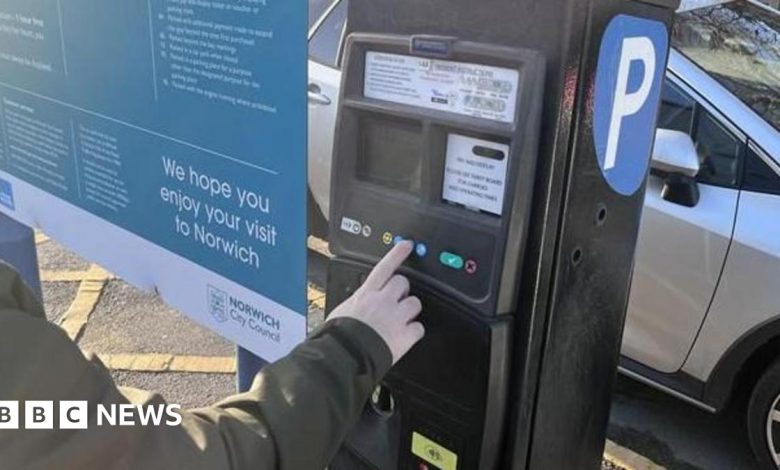
Parking Payment Challenges in Norwich: A Modern Dilemma
In Norwich, the simple act of parking has become unexpectedly complicated as payment systems at local car parks face technical difficulties. At Rouen Road car park, multiple drivers recently encountered a frustrating situation when they were unable to complete card payments. One woman described to the BBC how she and five other motorists found themselves stranded by malfunctioning payment machines, eventually having to call the out-of-hours service number listed on the parking meter. After being transferred to the city council, they received an unusual instruction: place handwritten notes on their dashboards explaining that the payment system wasn’t working – hardly a satisfying or secure solution for concerned drivers.
This parking predicament highlights a broader societal shift in how we handle everyday transactions. Many affected drivers noted that the problem was particularly troublesome because few people carry cash anymore, having embraced the convenience of contactless payments. This cultural transition to digital payments, while progressive in many ways, creates significant vulnerabilities when technology fails. The parking payment issues in Norwich exemplify how dependent we’ve become on functioning digital infrastructure for basic daily activities, and how disruptive it can be when these systems don’t work as expected.
James Wright, who leads the Liberal Democrats on Norwich City Council, emphasized the importance of reliable parking payment systems for both consumers and local businesses. His comments underscored that the timing couldn’t be worse, as the Christmas shopping season represents a crucial period for retailers who depend on accessible parking to attract customers. The situation illustrates how seemingly minor infrastructure issues can have cascading economic effects, potentially driving shoppers away from brick-and-mortar stores toward online alternatives where parking isn’t a concern.
Wright identified poor mobile connectivity as an underlying contributor to the problem, not just in Norwich but throughout the county. His observation points to a larger infrastructure challenge that affects many aspects of modern life beyond just parking. In an era where digital systems increasingly manage our daily activities, reliable network coverage becomes as essential as traditional utilities like electricity and water. The parking payment difficulties serve as a visible symptom of this less visible connectivity problem, bringing attention to digital infrastructure gaps that might otherwise go unnoticed by local officials.
For city residents and visitors, the parking payment problems represent more than a mere inconvenience—they create uncertainty and stress during what should be routine activities. Having to call special numbers, speak with council representatives, and leave notes on vehicles introduces unnecessary complexity and worry about potential parking fines despite good-faith efforts to pay. This experience contrasts sharply with the seamless, efficient urban experience that most modern cities strive to provide, and it may influence how people perceive Norwich’s overall quality of public services and infrastructure.
Addressing these parking payment challenges requires a multi-faceted approach that acknowledges how people actually live today. As Wright stated, “It needs to be easy for people to come in via whatever means of transport they want and if they are coming in by car, it needs to be easy for people to park in council car parks.” This common-sense perspective recognizes that functional, reliable payment systems aren’t luxury amenities but basic requirements for a well-functioning city. Norwich’s parking payment difficulties serve as a reminder that as we transition to increasingly digital civic systems, redundancy, reliability, and accessibility must remain central considerations in public infrastructure planning.






**mitolyn**
Mitolyn is a carefully developed, plant-based formula created to help support metabolic efficiency and encourage healthy, lasting weight management.