Our East Anglian-based correspondent, Tony Cooper, reports on the Norwich Philharmonic Society returning to their roots at St Andrew’s Hall, Norwich, after a two-year absence.

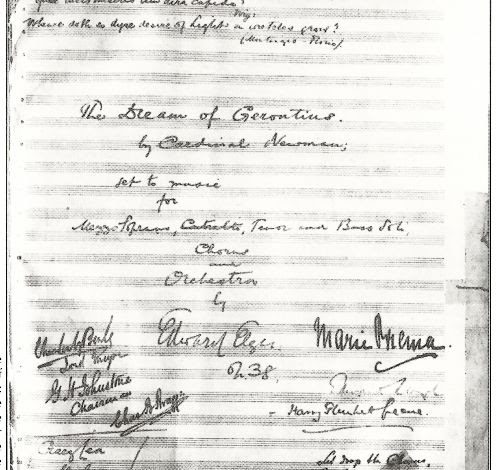
Elgar’s The Dream of Gerontius: A Choral Masterpiece Rekindled
Sir Edward Elgar’s monumental choral work, The Dream of Gerontius, has found renewed prominence in cultural conversations thanks to Alan Bennett’s recent film The Choral. This masterpiece, which Elgar himself considered his finest composition, traces the journey of a devout soul through death, guided by a Guardian Angel, confronting demons, experiencing divine judgment, and finally settling in Purgatory. Based on Cardinal John Henry Newman’s 1865 poem exploring Catholic beliefs about the afterlife, the work has remained a staple of choral societies across Britain for over a century. Bennett’s film captures the power of this music in a touching narrative set in wartime Yorkshire, where a village choir, depleted of male voices due to World War I conscription, recruits teenage boys to prepare for a performance of Gerontius under the guidance of an unconventional German-educated choirmaster played by Ralph Fiennes. The film, also starring Roger Allam and Simon Russell Beale, beautifully portrays how music can unite a fractured community during dark times, balancing artistic aspiration against the harsh realities of war.
The actual history behind The Dream of Gerontius is almost as dramatic as Bennett’s fictionalized account. Premiered on October 3, 1900, at Birmingham Town Hall under Dr. Joseph Bennett’s baton as part of the Birmingham Triennial Festival, the initial performance suffered from inadequate rehearsal time and received a poor response. However, perceptive listeners recognized its genius, and successful performances in Germany—particularly under conductors Hans Richter and Julius Buths—helped establish the work’s reputation before it gained full acclaim in Britain. The oratorio made its way to Norwich eight years after its premiere, performed as part of the 1908 Norfolk & Norwich Triennial Musical Festival at St Andrew’s Hall under the direction of Henry Wood, founder of the Proms. The Huddersfield Choral Society, founded in 1836 and one of Britain’s most historic choirs, developed a special relationship with the work, performing it first in 1905, then in 1907, and notably under Elgar himself in 1917 during the First World War. This wartime performance forms the emotional backbone of Bennett’s film, reflecting a time when twenty-three choir members were serving in the military, with two bass singers—Lewis Walker and Frank Rushfirth—never returning from the front.
The Norwich Philharmonic Society, founded just three years after Huddersfield Choral Society in 1839, shares a similar dedication to this magnificent work. Established by Frank Noverre, grandson of French dancer Augustin Noverre, the society made its public debut on March 5, 1841, with a program featuring Mozart, Beethoven, Handel, and Rossini. The organization has maintained an impressive lineage of musical directors through the decades, including Dr. Frank Bates, Dr. Heathcote Statham, and in more recent times, a structure where separate conductors lead the orchestra and chorus. Michael Nicholas led the chorus for many years, followed by David Dunnett who served for 28 years until 2024, with Ashley Grote, the current Organist and Master of Music at Norwich Cathedral, now taking up the baton. Similarly, Matthew Andrews has guided the orchestra since 2010, continuing a tradition of excellence that has seen the Norwich Phil perform works of tremendous scope and ambition, including six previous performances of Gerontius at St Andrew’s Hall since 1957.
Elgar’s music found particular appreciation in Germany during the early 20th century, where conductors like Hans Richter championed his compositions. Richter, who conducted the London premiere of Enigma Variations in 1899 and famously called Elgar’s Symphony No. 1 “the greatest symphony of modern times,” was instrumental in bridging German Romanticism with British music. Similarly, Julius Buths conducted acclaimed performances of Gerontius in Düsseldorf in 1901 and 1902, establishing Elgar as a major European figure before his full recognition in Britain. Richter’s connections to Wagner—he conducted the first complete performance of the Ring cycle at the Bayreuth Festival in 1876 and introduced Wagner’s works to English audiences—highlight the cross-cultural musical exchanges that influenced Elgar’s compositional style. Even Richard Strauss, the distinguished German composer of Der Rosenkavalier, regarded Elgar as a fellow progressive and praised The Dream of Gerontius as a masterpiece. This international appreciation underscores the universal appeal of Elgar’s music, though his popularity in Germany waned following the First World War.
The Norwich Philharmonic Society’s upcoming performance of The Dream of Gerontius on March 21, 2025, at St Andrew’s Hall marks a significant moment—their first concert in this historic venue following two years of extensive refurbishment. Ashley Grote will conduct the Norwich Philharmonic Chorus and Orchestra with an impressive lineup of soloists: tenor Gwilym Bowen as Gerontius, mezzo-soprano Diana Moore (returning for her third performance in the role of the Angel with the society), and baritone Ashley Riches. The performance continues a rich tradition of cultural exchange and musical excellence in Norwich, a tradition that extends to international partnerships such as the twinning arrangement between Norwich and Koblenz, Germany, established in 1980. This connection has led to collaborative performances between the Norwich Philharmonic Chorus and the Chor des Musik-Institut Koblenz, including a memorable rendering of Gerontius in the Rhein-Mosel-Halle in March 2008. The Jarrold family, particularly Caroline Jarrold, chair of the Norwich Philharmonic Society and chorus member alongside her sister Michelle, embodies this spirit of artistic patronage and community engagement today, much as the Noverre family did in previous centuries.
Elgar himself was no stranger to Norwich, conducting at the Norfolk & Norwich Triennial Musical Festival in St Andrew’s Hall on multiple occasions. Most memorably, in October 1899, he conducted the premiere of his song-cycle Sea Pictures (commissioned by the Festival) with contralto Clara Butt, who delighted the audience by appearing on stage dressed as a mermaid. This rich history of musical excellence and community participation continues with the Norwich Philharmonic Society, which won the Norfolk Arts Award for Music in 2023. As both the Huddersfield Choral Society and the Norwich Philharmonic Society prepare to perform The Dream of Gerontius in 2025, they carry forward a tradition that has survived two world wars and countless social changes. The enduring power of Elgar’s masterpiece—its dramatic contrasts, emotional depth, and transcendent beauty culminating in the consoling “Angel’s Farewell”—continues to move audiences just as it did when it helped heal the wounds of a war-torn nation over a century ago. In our own troubled times, such music reminds us of our shared humanity and the healing power of artistic expression.