Palm Sunday Procession Marks Beginning of Holy Week in Norwich
As the sun cast a gentle glow over the gardens of the Cathedral of St John the Baptist in Norwich this past Sunday, a gathering of the faithful assembled to participate in one of Christianity’s most solemn and meaningful traditions. The Palm Sunday procession, marking the beginning of Holy Week for the Diocese of East Anglia, brought together community members in a beautiful display of faith and remembrance. Against the backdrop of early spring, with buds beginning to emerge on nearby trees, the congregation stood in quiet anticipation, awaiting the arrival of Bishop Peter Collins and his accompanying ministers.
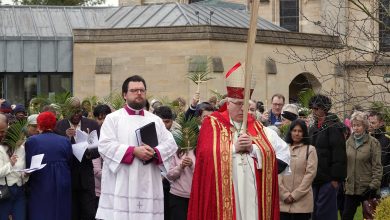
The air was filled with the melodious voices of the choir as Bishop Peter approached the gathered faithful. With warmth and sincerity, he welcomed everyone present, encouraging them not merely to observe but to participate “actively and consciously” in the celebration that would unfold. There was an intimate quality to his address, reminding those present that they weren’t simply spectators to an ancient ritual, but rather active participants in a living tradition that connects them to Christians across two millennia. The bishop then proceeded with the blessing of the palms, a deeply symbolic act that transforms simple branches into powerful reminders of Christ’s kingship. As he sprinkled holy water upon the palms held by the congregation, one could sense the significance of the moment—these weren’t just plants, but symbols of welcome and eventual sacrifice, connecting the joyful entry into Jerusalem with the somber events that would follow later in the week.
Following the blessing, Deacon Jonathan’s voice rose in the traditional Latin chant of “Procedamus in pace” (“Let us proceed in peace”), to which the congregation responded with heartfelt conviction, “In nomine Christi. Amen” (“In the name of Christ. Amen”). This exchange, brief yet profound, set the stage for the procession that would follow. The Gospel reading from Matthew 21:1-11 had just been proclaimed, painting a vivid picture of Jesus entering Jerusalem on a donkey while crowds spread garments and branches on the road before him. Now, in a humble echo of that triumphant entry, the Norwich faithful prepared to process with their own palms and prayers. There was something deeply moving about this continuity of tradition—ordinary people in 21st century England connecting with ordinary people from first-century Jerusalem, all acknowledging Christ in their midst.
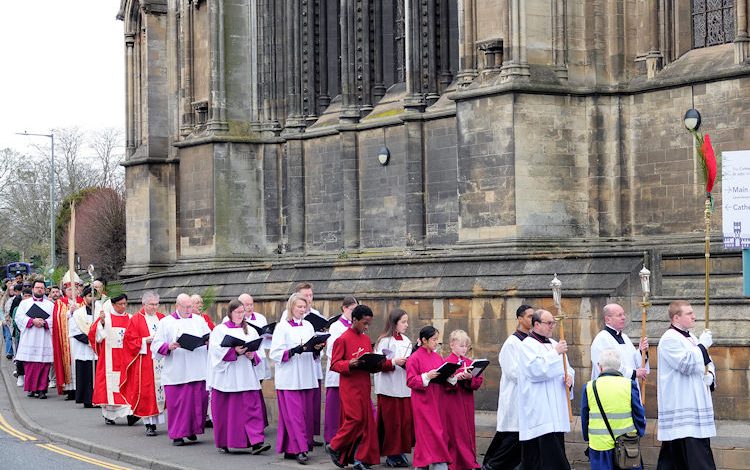
The procession began to take shape with meticulous attention to ancient tradition. Leading the way was the thurifer, swinging the thurible from which aromatic incense rose skyward like prayers ascending to heaven. Behind came the processional cross, held high as the central symbol of Christian faith, flanked by acolytes bearing candles whose flames flickered in the spring breeze. Following were the servers in their crisp garments, the choir whose voices had earlier filled the garden with song, the ministers in their liturgical vestments, and finally Bishop Peter himself, embodying the apostolic succession that links today’s Church with its earliest beginnings. Together, this solemn yet joyful procession made its way from the cathedral garden, out onto the public road, circling around before finally entering the magnificent Cathedral of St John the Baptist. As they walked, hymns filled the air, creating not just a religious ceremony but a public witness to faith—a living tableau that proclaimed through action rather than words the story of Palm Sunday. Passersby stopped to watch, some curious, some reverent, as this ancient ritual unfolded in the midst of modern Norwich.
When the procession had entered the cathedral and the Mass continued, Bishop Peter delivered a homily that connected the day’s historical remembrance with present spiritual needs. Speaking with pastoral concern, he encouraged the assembled faithful to gather more frequently in prayer, particularly during the sacred days of Holy Week that stretched ahead. There was a gentle urgency in his words, reminding all present that the liturgy isn’t merely a performance to observe but a relationship to cultivate—a deepening connection with Christ that comes through regular, intentional participation in the Church’s worship. The bishop’s words seemed to resonate through the cathedral’s vaulted spaces, inviting personal reflection on how each person might more fully enter into the mysteries being commemorated. As palms rustled in the hands of the congregation, one could sense the dual nature of the day—the joy of Christ’s recognition as king alongside the knowledge of the suffering that awaited him.
As the Mass concluded and the congregation dispersed, many carried not only blessed palms but a renewed sense of purpose for the week ahead. The Palm Sunday procession had accomplished what the best religious rituals do—it had connected heaven and earth, past and present, divine and human in a tangible, accessible way. The Diocese of East Anglia had begun its Holy Week journey with this public expression of faith, one that would continue through the solemn remembrances of Holy Thursday, Good Friday, and ultimately the joyful celebration of Easter Sunday. Photographs of the procession and Mass would later be shared online, allowing those who couldn’t attend to glimpse this beautiful tradition and perhaps feel inspired to participate in future celebrations. But for those who walked in the procession, sang the hymns, and received the blessed palms, the experience was more than images could capture—it was a lived connection to the very heart of their faith, a step on their own journey alongside Christ from hosannas to hallelujahs.