Norwich Chamber Music, formally Norfolk & Norwich Music Club, one of the oldest music clubs of its kind in the country, finds itself in celebratory mood shouting about its 75th anniversary.

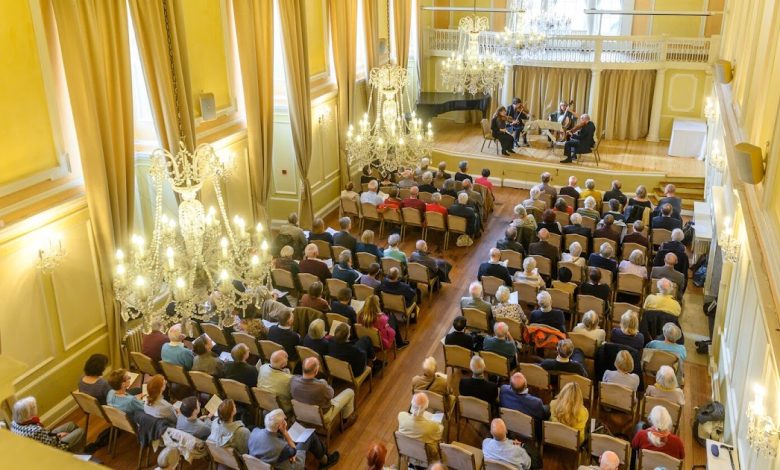
The Fitzwilliam Quartet at the Assembly House: 75 Years of Musical Excellence in Norwich
The story of Norwich Chamber Music (formerly the Norfolk & Norwich Music Club) begins against the backdrop of post-war recovery. On May 26, 1951, the London Harpsichord Ensemble performed the inaugural concert in the elegant Music Room of the Assembly House, a Georgian gem that had narrowly survived the devastating Baedeker raids of 1942. These bombings, retaliatory strikes by the Luftwaffe following RAF attacks on Lübeck, had left Norwich, like many English cities, struggling to rebuild. Yet amidst the reconstruction, cultural revival became a priority. Prior to the Music Club’s founding, Norwich’s classical scene was sparse, anchored primarily by the Norwich Philharmonic Society (founded in 1839). This amateur organization offered orchestral and choral concerts at St Andrew’s Hall with professional soloists, occasionally promoting celebrity recitals, but professional chamber music was virtually nonexistent. The newly formed Norfolk & Norwich Music Club aimed to fill this void, finding its home in the freshly restored Assembly House, a building with a rich musical heritage where Niccolò Paganini had performed in 1831 and Franz Liszt during his 1840 Grand Tour.
Under the leadership of W.J. Dearnaley, head of Town Close School and the club’s first chairman, the organization was determined to present music-making of the highest caliber. Benjamin Britten, the Suffolk-born composer who had strong ties to Norwich, was invited to become the club’s president. Though initially planned by committee, programming responsibilities soon fell to Miriam Cannell, appointed Honorary Secretary in March 1952. Over the next four decades, Cannell brought a parade of national and international musicians to Norwich, including renowned performers like Dennis Brain, Julian Bream, Paul Tortelier, and many distinguished string quartets from across Europe. Particularly passionate about promoting young talent, she welcomed emerging artists such as John Ogden, Stephen Bishop (Kovacevich), and the Lindsay, Chilingirian, and Takács quartets to Norwich at the start of their careers. Her warm hospitality encouraged many to return as their reputations grew. After more than 40 years of dedicated service and over 350 concerts, Miriam retired in 1996, celebrated with a special performance by the Nash Ensemble.
The baton passed to Norfolk-born music aficionado Roger Rowe, who served as programme organizer from 1996 until 2017, retiring at age 80 with an MBE for voluntary service to music. Rowe’s tenure was marked by memorable anecdotes – managing temperamental artists, solving logistical crises, and navigating unexpected challenges with diplomatic finesse. In April 1995, disaster struck when fire destroyed significant portions of the Assembly House, including the Music Room. During reconstruction, the club performed at various venues across Norwich. Upon returning to the restored Assembly House in 1997, new limitations on seating and parking prompted a search for a larger home. After a successful trial concert in May 1998, the club permanently relocated to the John Innes Centre in April 1999, a modern purpose-built auditorium with a 320-seat capacity, superior acoustics, improved facilities, and free parking – advantages that helped expand membership and programming.
The move to John Innes marked an era of growth and innovation. The concert season expanded from ten to fifteen performances annually, while adjoining seminar rooms enabled pre-concert talks and interviews with musicians. A chamber music weekend, pioneered in January 2000, became a popular fixture, curated over the years by distinguished artists including the Borodin Quartet, Natalie Clein, Michael Collins, Steven Isserlis, and pianists Julius Drake, François-Frédéric Guy, and Pascal Rogé. Special thematic series became another hallmark, with ambitious undertakings such as the Borodin Quartet’s complete Beethoven cycle in 2004 (six concerts over eight days) and their Shostakovich cycle in 2006 (fifteen quartets in five concerts), commemorating the composer’s centenary. Other notable cycles included the Guarneri Piano Trio’s complete Beethoven piano trios (2010), François-Frédéric Guy’s ten-concert traversal of Beethoven’s piano sonatas (2011), and the Takács Quartet’s complete Bartók quartets over a single weekend (October 2011). For their 60th anniversary in June 2011, the club returned symbolically to the Assembly House for a performance of Mendelssohn’s Octet by the Finzi and Idomeneo quartets.
The club has maintained a strong commitment to contemporary music, particularly commissioning new works from composers with local connections. For Benjamin Britten’s centenary in November 2013, four concerts featured nearly all his chamber works, honoring a composer with deep ties to Norwich who had studied viola in the city from age 10 and met his mentor Frank Bridge there. Since 1997, commissioned works have included David Bedford’s Second String Quartet (premiered 1997), David Matthews’ Eighth Quartet (1998), and multiple pieces by Norfolk-based composer Douglas Weiland during his eight-year residency. Other commissions have showcased the talents of Howard Skempton, Anna Meredith (the club’s first female commissioned composer), Gordon Crosse, and Kemal Yusef, many broadcast by BBC Radio 3. Following Roger Rowe’s retirement in 2017 (when he became club president), programming passed first to Misha Donat and then to Richard Wigmore for the 2023-24 season. Now rebranded as Norwich Chamber Music, the organization celebrates its 75th anniversary in 2026-27 with an exciting season featuring the Trio Gaspard, Fenella Humphreys and Jian Tong, the Pavel Haas Quartet, the Piatti Quartet with tenor James Gilchrist, and many other distinguished artists, culminating in a special anniversary event at the Assembly House on May 10, 2027, recreating the club’s very first concert from 1951.
Throughout its remarkable history, Norwich Chamber Music has evolved from modest post-war beginnings into one of Britain’s most respected chamber music societies. Through changing venues, expanding programming, and the passionate dedication of successive organizers, it has maintained an unwavering commitment to musical excellence. From hosting legendary performers like the Amadeus, Bartók, and Janáček quartets to commissioning new works and nurturing emerging talents, the organization has enriched Norwich’s cultural landscape for three-quarters of a century. As it approaches its diamond jubilee, Norwich Chamber Music continues to look forward while honoring its illustrious past, bringing world-class chamber music to appreciative audiences in East Anglia. The upcoming anniversary celebration not only marks 75 years of extraordinary music-making but also invites reflection on past accomplishments while anticipating new musical adventures on the road to its centenary.