


Bridging Borders, Building Faith: A Journey Through Nordic Connections
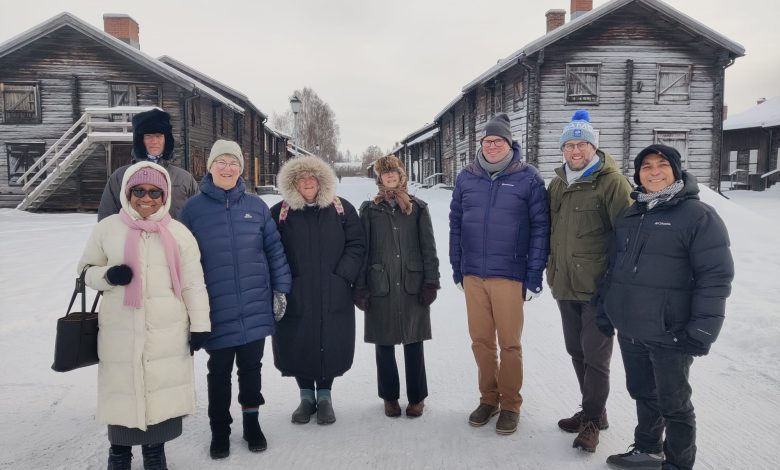
In the heart of Northern Sweden, amidst snow-blanketed landscapes and crisp winter air, a profound connection continues to thrive between the Diocese of Norwich and the Diocese of Luleå. As Bishop of Lynn, I recently led a delegation to strengthen this twenty-year partnership, experiencing firsthand how two rural dioceses—though separated by geography—share remarkable similarities and instructive differences. Both our regions consist primarily of scattered village populations, operating within the Porvoo communion of churches in full communion with each other. Yet while we navigate similar challenges as Western European churches with historical state connections, Luleå’s vast northern territory makes even our largest multi-parish benefices seem modest by comparison. The Swedish church maintained formal state church status until 2000—a relationship that differed from the Church of England’s established position—and still benefits from state building support and an optional “church tax” whereby parishioners can contribute roughly 1% of their income directly to parishes. With over half of Luleå’s population choosing to participate, this has enabled the development of highly regarded social outreach programs delivered through a well-developed diaconate.
Like many faith communities across Europe, both our dioceses are witnessing contrasting trends—a hopeful “quiet revival” among young people alongside challenges from rising Christian nationalism, declining regular attendance, and urgent questions about gospel proclamation in contemporary society. These shared challenges formed the backdrop for our participation in a conference in Skellefteå on “proclaiming the gospel in troubled times,” which included representatives from another Luleå partner, the Evangelical Lutheran Church in Liberia. In a world that feels increasingly precarious, the value of maintaining Christian connections across national borders becomes ever more vital—sharing both hopes and fears, sustaining relationships that might prove difficult to establish anew should geopolitical tensions increase. This reality felt particularly poignant in Piteå, where Russian soldiers lie buried in the churchyard, a sobering reminder of how quickly history’s shadows can lengthen across present-day realities. The Bishop of Liberia offered powerful reflections on rebuilding trust in war-torn contexts, addressing both physical and spiritual needs, and embracing rather than avoiding shared suffering—words that resonated deeply as we considered how European churches might better proclaim Christ’s love across increasingly fragmented societies.
Throughout our discussions, we shared Norwich Diocese’s vision—”Transformed by Christ: Prayerful, Pastoral, Prophetic”—emphasizing our need for personal transformation into Christ’s likeness through dedicated prayer. The conference created space for genuine fellowship across national and ethnic boundaries, with participants asking each other the fundamental questions: “What do you need?” and “What has God put in your hand?” These questions took on particular significance as we later explored the deeply painful history of the Sámi people—the indigenous inhabitants of northern Scandinavia who experienced generations of displacement, language suppression, and cultural erasure as Swedish settlers gradually claimed their traditional lands. Children were forcibly removed from families and placed in “Nomad” schools where they were forbidden to speak their native language and instead indoctrinated into Swedish culture and values. The trauma inflicted during this period remains immeasurable, with lasting consequences for today’s Sámi communities. While the Swedish church has issued two formal apologies and appointed a diocesan officer focused on reconciliation efforts, the ongoing work demands continued humility and the essential question: “What are the Sámi spiritual values, particularly those connected to land and nature, that must be allowed to flourish again and inform not just their Christian faith but potentially the whole Swedish church?”
Our encounters with Sámi individuals—including a priest, a member of the Sámi Parliament, and a young Sámi woman—were profoundly humbling. We recognized how much these indigenous communities could teach a world that has largely forgotten how to respect and care for our planet. The parallels with our own racial justice work in the Diocese of Norwich and the wider Church of England were striking and sobering. Several members of our delegation serve on Norwich Diocese’s Racial Justice Action Group, implementing recommendations from the “From Lament to Action” report. We were shocked to learn how research originating in Sweden had not only harmed the Sámi but eventually informed aspects of National Socialism and contributed to the horrors of World War II. These revelations reinforced our conviction that overcoming racism remains an imperative for all Christians and churches, inspired by Jesus’ example of breaking down the dividing walls of hostility (Ephesians 2:14).
Our Swedish hosts, like us, are actively discerning God’s direction for future ministry. While the Church of Sweden lacks archdeacons (whose functions are primarily handled by diocesan officers), they do share our structure of Rural Deans who gather clergy for support, advice, and sharing best practices. These deans serve time-limited appointments made by the Bishop after consulting with clergy in the deanery, functioning as vital strategic links between episcopal leadership and parish life. Our brief but meaningful time together included shared prayer, laughter, vulnerable conversations about challenges, and rediscovery of our common hope in God’s love. The breathtaking natural beauty of northern Sweden—temperatures of -22 degrees, pristine falling snow, and brilliant constellations under clear night skies—evoked C.S. Lewis’s description in “The Discarded Image” of the medieval universe as a vast celestial cathedral whose ceiling is illuminated by stars and planets singing to God’s glory. As the Northern Lights danced across the horizon and sunlight sparkled off snow-covered landscapes, my sense of wonder was reawakened in thanksgiving for all we had experienced.
Our colleagues’ reflections captured the essence of this transformative journey. Richard Lamey, Director of Mission and Ministry for Norwich Diocese, noted how our similar histories, societal positions, and challenges as Western European churches are balanced by different resources and instincts for addressing these shared contexts. Tim Yau, Rural Dean for Norwich North, found painful parallels between the Sámi experience and that of Gypsy, Roma, and Traveller communities in the UK, drawing hope from seeing how “repentance, though costly, can become a doorway to grace.” David Longe, Rural Dean of Holt Deanery, was particularly struck by Sweden’s distinctive approach to the diaconate, which emerged from the Deaconess movement of the 1830s and now comprises about 80 deacons providing vital social outreach across the diocese. In a world of increasing division, the knowledge that Christians across borders are praying for one another’s flourishing stands as a powerful testimony to the unifying love of Christ that transcends all boundaries.



Your articles always leave me thinking.