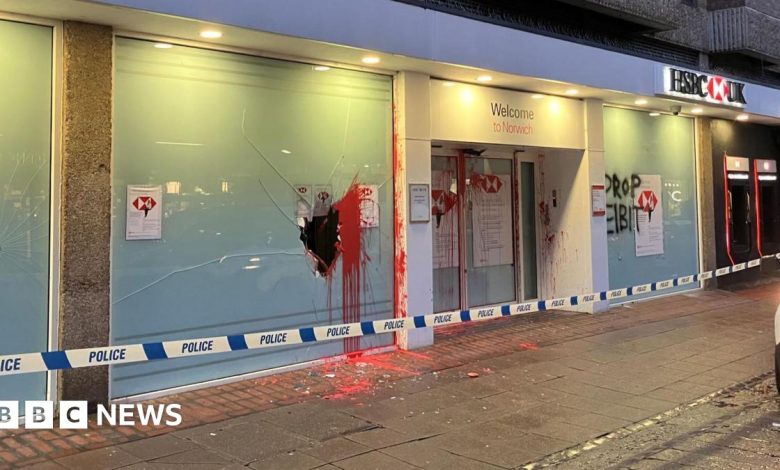
HSBC Branch in Norwich Vandalized with Red Paint and Anti-Arms Trade Message
In the early hours of the morning, a branch of HSBC in Norwich became the target of vandalism when unknown individuals splashed red paint across its facade and smashed several windows. The incident occurred at the bank’s London Street location, which was already closed to customers due to ongoing refurbishment work. The attackers left behind a clear message painted on the building: “DROP EIBIT,” which appears to be a reference to Elbit Systems UK, a Bristol-based company that manufactures and sells military equipment. This act of vandalism seems to be a form of protest against either HSBC’s potential financial ties to the arms industry or specifically to Elbit Systems, though the exact motivation remains unconfirmed.
The damage was discovered in the pre-dawn hours, with Norfolk Police responding to reports of the incident at approximately 1:25 GMT. Upon arrival, officers established a protective cordon around the building to secure the scene while they began their investigation. The dramatic appearance of the branch, with vivid red paint symbolically resembling blood splattered across its exterior, created a striking scene for early morning commuters and residents in Norwich’s city center. The deliberate nature of the vandalism, including both the destructive elements and the specific messaging, suggests this was a planned protest action rather than random property damage.
This incident highlights the increasingly visible tensions surrounding financial institutions’ investments in or relationships with defense contractors and the military industrial complex. Elbit Systems, the company referenced in the graffiti, is one of Israel’s largest defense contractors with a significant UK presence, specializing in various military technologies including drones, surveillance systems, and other equipment. In recent years, activist groups have targeted banks and financial institutions they believe support or invest in companies involved in controversial military operations or weapons manufacturing, particularly those with connections to conflicts that have resulted in civilian casualties.
For Norwich residents, the vandalism represents an unusual disruption in their historic city center, bringing global political issues directly to their local high street. The HSBC branch, situated on London Street in the heart of Norwich’s commercial district, is normally a busy financial hub serving local businesses and residents. The timing of the incident during an already-planned refurbishment period means that while the damage is visually striking and will require additional repair work, it has not immediately disrupted banking services for customers who would normally use this branch, as they had already been redirected to alternative locations.
The police investigation will likely include reviewing CCTV footage from the area and conducting forensic examinations to identify those responsible for the vandalism. Acts like these present complicated challenges for law enforcement, as they balance protecting property and maintaining order with recognizing the political expression that often motivates such incidents. While damaging property remains a criminal offense regardless of the motivation, the context of protest adds a dimension that extends beyond typical vandalism cases. Meanwhile, both HSBC and Elbit Systems will likely be assessing their security protocols and public relations strategies in response to being highlighted in this manner.
This incident joins a pattern of similar protests targeting banks and financial institutions across the UK and globally, where activists use direct action to draw attention to corporate investments they consider ethically problematic. While some view such actions as counterproductive vandalism that ultimately costs public resources to address, others see them as necessary tactics to bring attention to issues that might otherwise remain invisible to the general public. As corporations face increasing pressure to consider the ethical implications of their investments and business relationships, incidents like the one at Norwich’s HSBC branch represent the visible manifestation of deeper societal debates about responsibility, complicity, and accountability in global finance and its relationship to international conflicts and the defense industry.