A Life of Faith and Melody: Celebrating Bishop Timothy Dudley-Smith
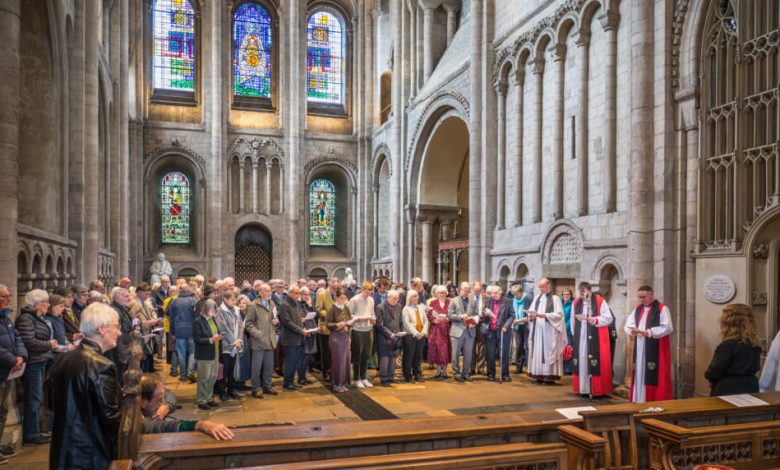
Norwich Cathedral resonated with hymns of praise on Sunday, March 22, as a special Choral Evensong commemorated the remarkable life and legacy of Bishop Timothy Dudley-Smith. The service marked the dedication of a memorial stone in the Cathedral’s North Transept for a man whose words have touched countless lives across the global Christian community. Bishop Timothy served as Archdeacon of Norwich from 1973 to 1981 before becoming Bishop of Thetford until his retirement in 1991. His passing in August 2024 at age 97 closed a chapter on one of Christianity’s most prolific modern hymn writers, with over 450 compositions to his name including beloved standards like “Tell Out, My Soul” and “Lord, for the Years” – both fittingly performed during the memorial service.
Family members, including his son The Reverend James Dudley-Smith who read the first lesson, gathered alongside friends and admirers to honor a man whose words continue to resonate in churches worldwide. Songs of Praise presenter Pam Rhodes participated in the service, reading the second lesson and introducing another of Bishop Timothy’s beautiful works, “Name of All Majesty.” The Right Reverend Graham Usher, Bishop of Norwich, delivered a moving sermon highlighting how Timothy’s desire to “see Jesus” shaped his entire life and creative output. This simple yet profound spiritual quest became the cornerstone of his ministry and hymnody, with Bishop Graham noting how even during family holidays in Cornwall, Timothy would carve out morning writing hours from 8:30 to 11:00 AM – “eyes seeking to see Jesus, pen and notebook in hand, tunes playing in his mind, words of scripture dancing and settling.”
The memorial service centered on the biblical text from John 12, where Greek seekers approached with the request: “Sir, we wish to see Jesus.” This desire for spiritual encounter rather than mere explanation perfectly captures Timothy’s approach to faith and writing. Bishop Graham reflected that Timothy’s hymns take this same longing – “to see, to know, to follow Christ” – and give it language that is both clear and searching. His compositions move beautifully from personal yearning to communal proclamation, transforming individual spiritual journeys into shared expressions of faith. Timothy’s gift was creating lyrics that didn’t simply discuss Jesus theoretically but invited singers to witness and embody Christ’s character through their own lives.
Bishop Graham identified three unlikely places where Timothy’s hymns help us see Jesus in our world today. First, in “the poorest, the lost, the least and the lonely; those who the world so often forgets.” He recalled singing Timothy’s hymn “Fill your hearts with joy and gladness” with Tanzanian Christians suffering from climate-induced crop failures – people finding spiritual sustenance through these words despite material hardship. Second, we see Jesus in the persecuted faithful worldwide, those who “have had to gather to pray in secret, have had to hide their Bible, and those who have had to flee their homes and become refugees because the name of Jesus is etched not on stone but on their hearts.” Timothy’s hymns offer solidarity and hope to Christians enduring such trials. Finally, we glimpse Jesus in Christ-like people living the Gospel daily – “the meek, the merciful, the pure in heart, the peacemakers” who embody Jesus’ teachings in contemporary contexts.
The memorial stone dedicated during the service, carved in Derbyshire limestone from Timothy’s childhood region, symbolizes how his earthly journey has come full circle. As Bishop Graham poignantly observed, “From his childhood in Buxton God carved Timothy out from the Derbyshire stone in which he was set and gave him life, with the name Jesus etched on Timothy’s heart and proclaimed with his lips. Now, as we dedicate a plaque to his memory, Timothy’s name is chiselled again into Derbyshire limestone, but God’s Holy Word echoes through his hymns to be written in our hearts.” This physical memorial stands as a reminder of Timothy’s enduring spiritual impact through words that continue to be sung with conviction across denominational lines and national boundaries.
Timothy Dudley-Smith’s legacy transcends his ecclesiastical titles or even his impressive hymn catalog. What the Norwich Cathedral service ultimately celebrated was a life consistently oriented toward Jesus – a man who helped countless others see Christ more clearly through the gift of sacred poetry. The concluding words of his final sermon as Bishop of Thetford in Norwich Cathedral were simply, “And to him be the glory.” This humble redirect of attention away from himself and toward the divine exemplified Timothy’s lifelong ministry. As his memorial stone takes its place in the cathedral he served, his hymns continue their greater work: challenging believers to make God “the Lord of our lives” and “to live for Christ alone.” In an age of fleeting words and disposable culture, Timothy Dudley-Smith crafted verses that endure, inviting new generations to join in the ancient, ongoing quest to see Jesus.