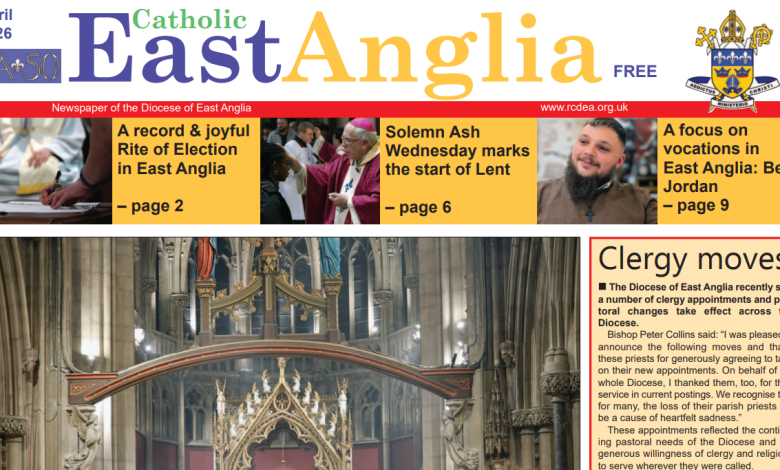
Catholic East Anglia Newspaper: April 2026 Edition Now Available
The April 2026 edition of the Catholic East Anglia newspaper has been released digitally, with physical copies set to arrive in parishes throughout the Diocese of East Anglia by Sunday, March 29. This latest issue brings together important stories from across the Catholic community in East Anglia, providing both current news and historical context for readers. The publication continues its tradition of being freely available to all—whether regular Mass attendees or those who are simply interested in keeping up with Catholic events and perspectives in the region.
Among the featured stories in this edition is comprehensive coverage of the Rite of Election ceremony recently held at the Cathedral of St John the Baptist. This significant liturgical event marks an important milestone for catechumens and candidates preparing to enter the Catholic Church, typically occurring at the beginning of Lent. The newspaper’s coverage likely details the experiences of those participating in this meaningful ritual, sharing personal testimonies and capturing the sense of community that such gatherings foster within the diocese. The Rite of Election represents a pivotal moment in the faith journey of many individuals, and the newspaper’s coverage helps to connect readers with these moving personal stories of spiritual growth.
Another highlight of this April edition is an extensive report exploring the history and significance of Walsingham, one of England’s most important pilgrimage sites and a location of tremendous spiritual significance for Catholics in Britain. Often referred to as “England’s Nazareth,” Walsingham has been a place of pilgrimage since the 11th century, when according to tradition, the Virgin Mary appeared in a vision to a noblewoman named Richeldis de Faverches. The article presumably delves into both the historical aspects of this sacred site and its continuing importance in contemporary Catholic life. By exploring Walsingham’s rich heritage, the newspaper connects readers to a deep tradition of English Catholicism that predates the Reformation, offering a sense of historical continuity and cultural identity.
The newspaper’s publishers are encouraging wide distribution of this April edition, inviting readers to share copies with friends and acquaintances who might not regularly attend Mass. This outreach effort reflects a broader commitment within the Diocese of East Anglia to engage with the wider community and make Catholic perspectives and stories accessible to all. The free nature of the publication eliminates financial barriers to access, while the encouragement to share creates organic networks of distribution that extend beyond church walls. This approach recognizes that in an increasingly digital age, physical publications still hold value as tangible connections to community life and as accessible means of sharing information with those who might not seek it out online.
For those who prefer digital access, the newspaper offers multiple electronic formats, including a standard PDF download and an interactive page-turning edition with embedded web links. This dual-format approach enhances accessibility, allowing readers to engage with the content in whatever manner best suits their preferences and needs. Additionally, the diocese maintains a regular online news service, which readers can subscribe to by completing a form on the diocesan website. This multi-platform strategy reflects the evolving nature of media consumption habits while ensuring that traditional print readers and digitally-focused audiences are equally well-served.
Beyond its role as a news source, the Catholic East Anglia newspaper serves as an important tool for community building and identity formation within the diocese. By sharing stories of faith, chronicling local events, exploring historical traditions, and highlighting the experiences of community members, the publication helps to nurture a sense of belonging and shared purpose among Catholics in East Anglia. In an age where many traditional media outlets are struggling, this diocesan newspaper continues to fulfill a vital function in connecting people to their faith community, preserving traditions, and fostering a collective narrative that spans both centuries of history and the diverse experiences of present-day believers throughout Norfolk, Suffolk, Cambridgeshire, and the surrounding areas.