Bronze Age gold tripartite penannular ring deemed as treasure after discovery in Newton Flotman near Long Stratton

A Bronze Age Marvel: The Gold Tripartite Penannular Ring of Newton Flotman
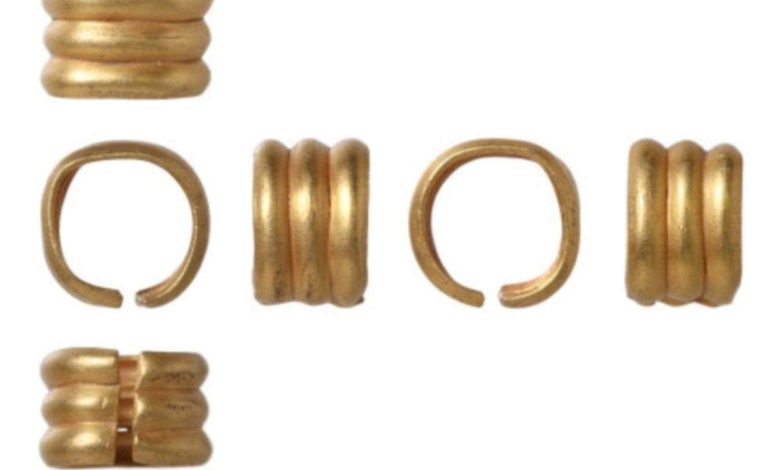
In a remarkable discovery near Long Stratton, a metal detectorist has unearthed a precious Bronze Age artifact that offers us a glimpse into the sophisticated craftsmanship of our ancestors. The gold tripartite penannular ring, found in the village of Newton Flotman, has recently been officially classified as treasure at Norfolk Coroner’s Court on February 27. This designation highlights not only the ring’s material value but also its significant historical importance to our understanding of Bronze Age metallurgy and artistic expression. The term “penannular” refers to the ring’s distinctive design, featuring a small gap in its otherwise complete circular shape – a characteristic feature of certain ancient jewelry and decorative objects that continues to intrigue archaeologists and historians alike.
The craftsmanship displayed in this ancient gold ring is truly extraordinary, showcasing the remarkable technical skills possessed by Bronze Age artisans. The artifact consists of three C- or U-section gold strips meticulously arranged parallel to one another and joined along their edges with gold solder. This construction technique demonstrates a sophisticated understanding of metalworking that would challenge even modern jewelers working without contemporary tools. The precision required to align and permanently join these delicate gold components speaks to the patience, steady hands, and expertise of its creator. When we consider that this was accomplished thousands of years ago without the benefit of modern magnification, lighting, or specialized tools, the achievement becomes even more impressive – a testament to human ingenuity and artistic vision across the millennia.
According to Helen Geake, Norfolk’s finds liaison officer, objects of this type are relatively common from the Bronze Age period, yet their specific purpose remains something of a mystery that continues to puzzle archaeologists. Despite the uncertainty surrounding their exact function, what remains clear is the significant investment of skill and resources that went into creating such pieces. Gold was a precious material in ancient times just as it is today, and dedicating such a valuable resource to create an ornate object suggests its importance within Bronze Age society. Was it a personal adornment worn by elite members of society? Perhaps it served a ritualistic purpose in ceremonies or religious observations? Or maybe it functioned as a form of portable wealth, similar to how we might think of valuable jewelry today. The questions surrounding its purpose add an intriguing layer of mystery to this beautiful artifact.
The discovery highlights the continuing importance of responsible metal detecting in expanding our knowledge of ancient Britain. While archaeological excavations provide carefully contextualized discoveries, detectorists who follow proper reporting protocols like the finder of this ring contribute significantly to our collective understanding of the past. Each properly recorded find adds another piece to the complex puzzle of ancient life. This particular discovery joins a growing catalog of Bronze Age metalwork from Norfolk and beyond, gradually helping archaeologists build a more comprehensive picture of trade networks, cultural practices, and artistic traditions from this fascinating period of British prehistory. These small, individual discoveries, when properly documented and studied, contribute to major advances in our understanding of ancient societies.
The technical achievement represented by this ring cannot be overstated. As Helen Geake noted, creating such an object required considerable metalworking expertise. The artisan needed to precisely shape multiple gold wires, align them perfectly, and then permanently join them using soldering techniques that required careful control of temperature and timing. One small error in the process could have ruined the entire piece. This level of technical accomplishment suggests a specialized craftsperson, perhaps someone who dedicated years to perfecting their skills in metalworking. It also indicates a society with sufficient specialization and resources to support such craftsmanship – not just anyone could create such objects, suggesting a complex social structure with specialized roles and training systems for transmitting technical knowledge across generations.
Norwich Castle Museum now hopes to acquire this treasure, where it would join other significant Bronze Age artifacts in their collection and be preserved for future generations to appreciate and study. If acquired, visitors will have the opportunity to marvel at this ancient craftsperson’s skill and imagine the world in which such beautiful objects were created and used. Museums play a crucial role in not just preserving such treasures but in telling their stories – connecting modern visitors with the lives and achievements of people who lived thousands of years ago. Through displays of artifacts like this tripartite penannular ring, we’re reminded that our ancestors were not simplistic people but skilled, creative individuals who developed sophisticated techniques and created objects of lasting beauty. Though separated by millennia, we can still appreciate and be moved by their artistic achievements, creating a profound connection across time that enriches our understanding of human creativity and technical innovation.