The partnerships helping All Saints, Marsham cultivate churchyard biodiversity while keeping the space ‘tidy’

Nurturing Nature’s Sanctuary: All Saints Church’s Environmental Mission
In the heart of Marsham, All Saints Church is embarking on a meaningful journey to transform its churchyard into a thriving wildlife haven while respecting the diverse needs of its community. This delicate balancing act represents a growing trend among church communities across the country who are increasingly recognizing their potential to serve as stewards of both spiritual and natural life. The challenge, however, lies in harmonizing ecological objectives with limited financial resources and the traditional expectations that church grounds should maintain a certain level of tidiness. All Saints has approached this challenge with creativity and community spirit, demonstrating how sacred spaces can evolve to embrace environmental responsibility without compromising their primary function as places of worship and remembrance.
The church’s environmental initiatives have gained momentum through strategic partnerships with influential regional organizations. Working hand-in-hand with the Norfolk Wildlife Trust and the Diocese of Norwich Churchyard Conservation Scheme has provided All Saints with valuable expertise and resources. Most recently, the Parochial Church Council approved an ambitious plan to plant 120 saplings of mixed hedging along the churchyard’s perimeter – a project made possible through The Woodland Trust’s generous donation of all necessary plants. This collaboration highlights the power of partnership in environmental stewardship, showing how churches with limited budgets can access resources through conservation organizations eager to support biodiversity efforts in community spaces. The church’s fabric officer, Nicola Hibberd, has been instrumental in cultivating these relationships and bringing the vision to life, recognizing that environmental work is most sustainable when shared across organizations with complementary expertise.
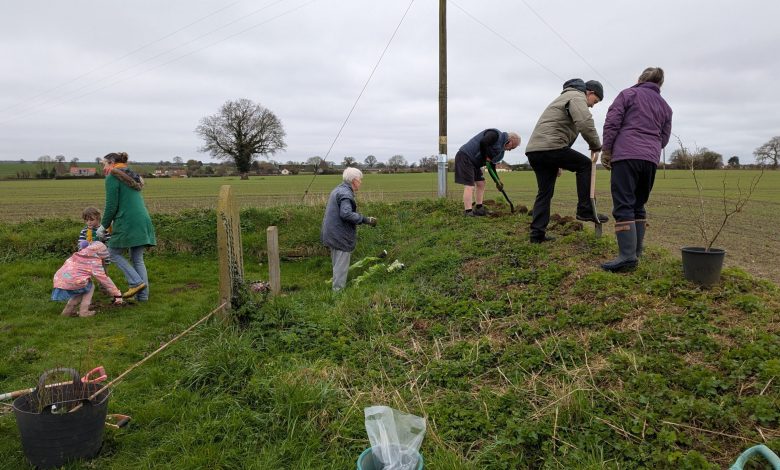
Perhaps the most inspiring aspect of All Saints’ environmental journey has been the enthusiastic response from the local community. When Hibberd published an appeal for volunteers in Marsham’s village newsletter, residents of all ages stepped forward, eager to contribute their time and energy to the church’s green initiative. This multigenerational group of volunteers recently gathered for their first planting session, working together to plant saplings while clearing weeds and nettles from the churchyard. Their collective effort reflects a beautiful synergy between faith and environmental consciousness, bringing together people who might otherwise never have connected. The project has created a space where conversations about spirituality and ecology can naturally intertwine, enriching both the church community and the local ecosystem. As Hibberd notes, “It is encouraging that so many members of our community want to be involved in our eco projects at the church.”
The first volunteer day proved remarkably productive, with participants managing to plant an entire bank of saplings while enjoying each other’s company in the peaceful church grounds. The palpable sense of accomplishment and community bonding has inspired Hibberd to apply for additional saplings, which are expected to arrive in November. This ongoing commitment demonstrates how environmental initiatives can become self-sustaining once they gain momentum within a community. The success of the planting day illustrates that church environmental projects offer multiple benefits beyond ecological improvement – they create opportunities for meaningful social connection, physical activity in the fresh air, and the satisfaction that comes from contributing to a legacy that will benefit future generations. The hedging, which will mature in the coming years, represents both a gift to wildlife and an investment in the church’s relationship with its community.
All Saints has thoughtfully implemented a nuanced approach to churchyard management that honors both environmental objectives and human needs. The gardening and maintenance team follows a carefully considered grass-cutting plan recommended by the Norfolk Wildlife Trust, creating distinct zones within the churchyard to serve different purposes. In the older section, wildflower areas are permitted to flourish, providing essential habitat for pollinators and other wildlife. Meanwhile, in the newer areas still used for burials, grass is kept somewhat shorter to accommodate the preferences of those visiting loved ones’ graves, many of whom desire a more manicured appearance. This zoned approach represents a sophisticated compromise that acknowledges the churchyard’s dual role as both ecosystem and place of remembrance. It demonstrates that environmental stewardship need not be all-or-nothing but can be adapted to honor multiple values simultaneously.
The transformative work at All Saints Church serves as an inspiring model for other faith communities considering similar initiatives. Through thoughtful partnerships, community engagement, and balanced management practices, the church is demonstrating how sacred spaces can evolve to meet contemporary environmental challenges while honoring their traditional roles. As Hibberd reflects, the hedging will “encourage more wildlife over the coming years and provide an environment where people want to spend time outdoors as well.” This vision encapsulates the holistic approach that makes All Saints’ environmental mission so compelling – it’s not merely about plants and wildlife but about creating a space where nature and spirituality enhance one another, where the community can gather to appreciate beauty in all its forms, and where the church can fulfill its calling to be a good steward of creation. For churches interested in following a similar path, resources and guidance are available through the Diocese of Norwich’s biodiversity initiatives, offering a supportive framework for communities ready to embrace their potential as guardians of both faith and nature.